
Hay un oficio del que casi nadie habla en público y que existe, con distintos nombres, en casi todas las casas y family offices de verdadera complejidad. El trabajo se juzga solo por lo que falla. Lo que funciona nunca se nota.
En noviembre sale la Professional Edition de El Oficio Invisible de Jorge Lores en Estados Unidos y Europa. No es un libro motivacional ni un compendio de teorías elegantes. Es un manual práctico escrito desde dentro del oficio: residencias privadas, family offices, ejecutivos de alta exposición y la lógica silenciosa que sostiene esas vidas sin fricción.
La idea central se formula pronto y no se abandona: se nota lo que falla, nunca lo que funciona. A partir de esa premisa Lores despliega un marco claro y utilizable. Explica por qué la invisibilidad no es sumisión, cómo anticipar dos movimientos antes, cómo leer el silencio del empleador con la misma atención que se lee una agenda, cómo construir criterio propio cuando no se puede preguntar constantemente y cómo decidir cuándo actuar en solitario y cuándo consultar. La parte dedicada a la discreción operativa es especialmente valiosa: qué se dice, a quién, por qué canal, qué nunca se escribe y cómo convertir la confidencialidad en una estructura real y no en una promesa vacía.
El libro distingue los mapas de riesgo según el entorno —household, family office, oficina del empleador— y dedica capítulos sólidos al driver de confianza, a la seguridad y privacidad (amenazas según estatus, huella digital, dispositivos, proveedores, hijos, viajes a países de riesgo), a la gestión de crisis, a las lealtades en conflicto y a los dilemas éticos reales que aparecen cuando el dinero, los regalos, las separaciones o la salud del empleador entran en juego. Cada capítulo cierra con escenarios prácticos que funcionan como ejercicios inmediatos de criterio.
La Professional Edition incorpora herramientas operativas concretas: checklists, plantillas de onboarding, protocolos de viaje y trabajo de avanzada, matriz de riesgos, política de dispositivos, ficha del driver, acuerdo de agenda con el ejecutivo y registro de incidentes. También aborda con claridad el uso de tecnología e inteligencia artificial: qué se puede delegar y qué no, cómo proteger la privacidad en una casa conectada y cómo mantener el criterio humano por encima de las herramientas.
Lores equilibra la exigencia técnica con la dimensión humana del trabajo: el burnout del imprescindible, cómo sostener el ritmo sin desaparecer como persona, la relación de confianza y distancia con el empleador, los contratos, la compensación, los idiomas, las redes y las transiciones de carrera. El tono es directo, sobrio, sin postureo. Cada página transmite la ética de la discreción que el propio oficio exige.
El Oficio Invisible no pretende convertir a nadie en héroe. Pretende convertir a profesionales serios en mejores profesionales: más anticipativos, más sólidos y más sostenibles. Una obra de referencia para quien ya ejerce el oficio y quiere elevar su nivel, para quien aspira a entrar en él con los ojos abiertos, y también para empleadores que deseen entender qué es realmente un gran Personal Agent y cómo sacarle el máximo partido sin destruirlo.
Disponible a partir de noviembre en Estados Unidos y Europa.
English version
The book that puts a name to the invisible job.
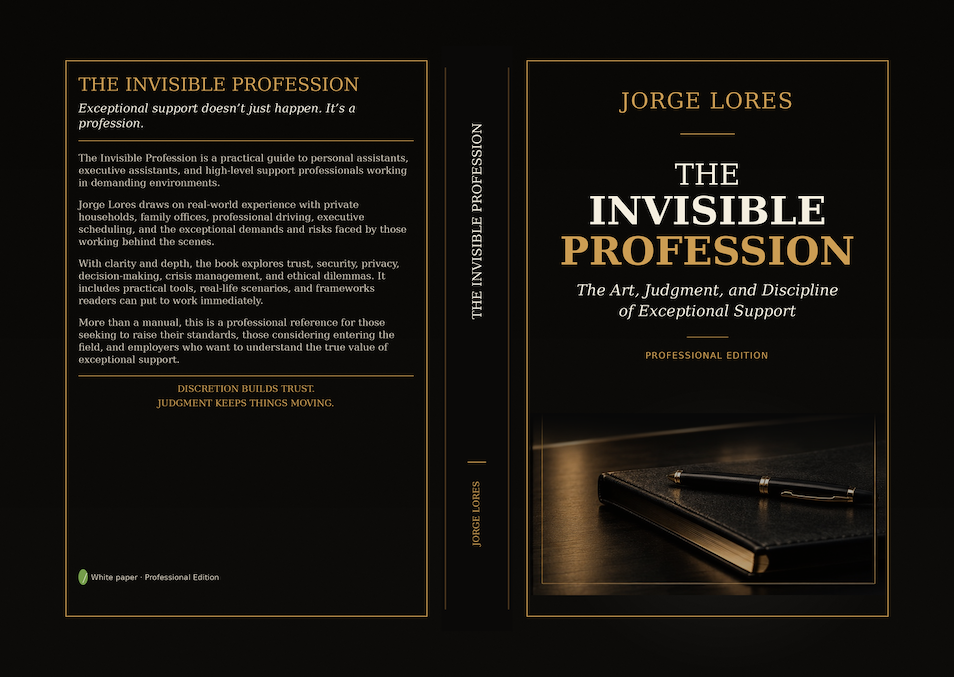
«The Invisible Profession » arrives in November.
There is a profession that almost no one talks about in public and that exists, with different names, in nearly every household and family office of real complexity. The work is judged only by what fails. What works is never noticed.
In November, the Professional Edition of El Oficio Invisible by Jorge Lores will be released in the United States and Europe. It is not a motivational book, nor a collection of elegant theories. It is a practical manual written from inside the job: private residences, family offices, high-exposure executives, and the quiet logic that keeps those lives running without friction.
The central idea is stated early and never abandoned: you notice what breaks; you never notice what works. From that premise Lores builds a clear, usable framework. He explains why invisibility is not submission, how to anticipate two moves ahead, how to read an employer’s silence with the same attention given to an agenda, how to develop independent judgment when constant questions are not an option, and how to decide when to act alone and when to consult. The section on operational discretion is especially useful: what is said, to whom, through which channel, what is never written down, and how confidentiality becomes a real structure rather than an empty promise.
The book distinguishes risk maps according to environment — household, family office, employer’s office — and dedicates solid chapters to the trusted driver, security and privacy (threats linked to status, digital footprint, devices, vendors, children, travel to high-risk countries), crisis management, conflicting loyalties, and the ethical dilemmas that appear when money, gifts, separations or the employer’s health enter the picture. Each chapter closes with practical scenarios that function as immediate exercises in judgment.
The Professional Edition adds concrete operating tools: checklists, onboarding templates, advance travel and work protocols, a risk matrix, device policy, driver profile sheet, agenda agreement with the executive, and an incident log. It also addresses technology and artificial intelligence with clarity: what can be delegated and what cannot, how to protect privacy in a connected house, and how to keep human judgment above the tools.
Lores balances technical demand with the human side of the work: the burnout of the indispensable person, how to sustain the pace without disappearing as a person, the relationship of trust and distance with the employer, contracts, compensation, languages, networks and career transitions. The tone is direct, sober, free of posturing. Every page carries the ethics of discretion that the profession itself requires.
El Oficio Invisible does not try to turn anyone into a hero. It aims to turn serious professionals into better ones — more anticipatory, more solid, more sustainable. A reference work for those already in the job who want to raise their level, for those who want to enter it with open eyes, and for employers who wish to understand what a true Personal Agent actually is and how to get the best from the role without destroying the person who fills it.
Available from November in the United States and Europe.