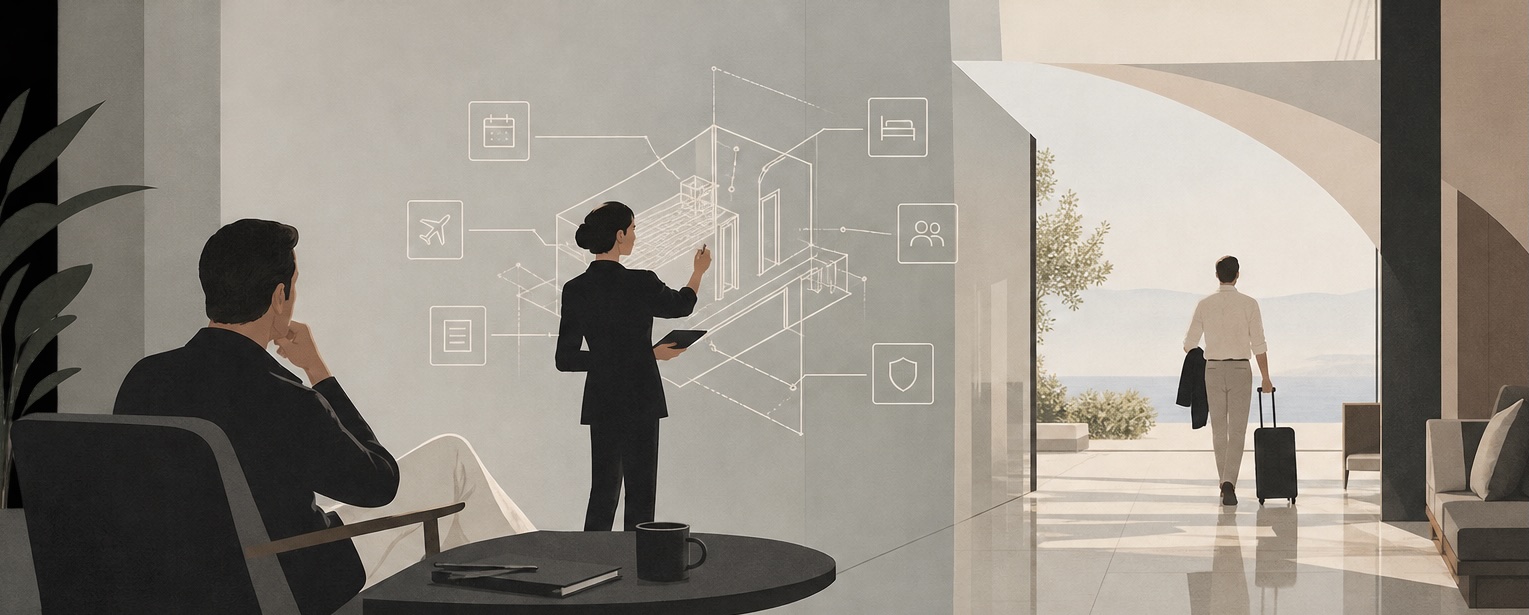

Hay una diferencia de fondo entre resolver problemas y diseñar un entorno donde esos problemas dejan de aparecer. Un Personal Agent senior o experimentado no se distingue por resolver más incidentes, sino por reducir, con el tiempo, el número de incidentes que llegan a producirse.
A esto se refiere la idea de arquitectura silenciosa. Un arquitecto no está presente cuando alguien camina por un pasillo bien iluminado o encuentra la puerta exactamente donde la esperaba; su trabajo se disuelve en la experiencia de quien habita el espacio. De la misma forma, un Personal Agent que diseña bien su función deja de aparecer en los momentos de fricción, porque ha construido, antes de que la fricción llegara, la estructura que la evita: una rutina semanal que no necesita renegociarse cada lunes, un protocolo de viaje que no necesita reinventarse en cada aeropuerto, un sistema de información que hace llegar al empleador lo relevante sin que tenga que pedirlo.
Esta arquitectura tiene tres materiales principales. El primero son los valores por defecto: decisiones ya tomadas de antemano —qué hotel, qué asiento, qué tipo de reunión requiere confirmación previa— que evitan renegociar lo mismo una y otra vez. El segundo son los flujos de información: quién necesita saber qué, cuándo, y por qué canal, de forma que la información relevante llegue sola, sin depender de que alguien recuerde pedirla. El tercero son los rituales de revisión: momentos fijos, casi invisibles para el empleador, en los que el propio Personal Agent audita si esa arquitectura sigue funcionando o necesita ajustarse.
Conviene subrayar algo que separa esta idea de la simple eficiencia operativa: la arquitectura de la que hablamos no impone una vida al empleador, la sirve. El buen arquitecto pregunta cómo vive alguien antes de decidir dónde poner la puerta; no impone su propio gusto sobre el espacio ajeno. De la misma manera, el Personal Agent que diseña sistemas sin escuchar primero el ritmo real del empleador —su forma de decidir, su tolerancia al riesgo, lo que de verdad le importa— no está construyendo una arquitectura útil, está construyendo una jaula cómoda para sí mismo. La escucha previa, silenciosa y prolongada, es la parte del oficio que menos se ve y más determina si todo lo demás funciona.
There is a fundamental difference between solving problems and designing an environment in which those problems no longer arise. A senior or experienced Personal Agent is not distinguished by the number of incidents they resolve, but by their ability to reduce, over time, the number of incidents that occur in the first place.
This is what the idea of silent architecture is all about. An architect is not present when someone walks down a well-lit hallway or finds a door exactly where they expected it to be; the architect’s work dissolves into the experience of the person inhabiting the space. In the same way, a Personal Agent who designs their role well becomes less visible at moments of friction because they have already built the structures that prevent it: a weekly routine that does not need to be renegotiated every Monday, a travel protocol that does not need to be reinvented at every airport, an information system that delivers what matters to the employer without requiring them to ask for it.
This architecture rests on three main building blocks. The first is defaults: decisions made in advance—preferred hotels, seating choices, and the types of meetings that require prior confirmation—that eliminate the need to renegotiate the same things over and over again. The second is information flows: who needs to know what, when, and through which channel, so that relevant information reaches the right people automatically, without depending on someone remembering to request it. The third is review rituals: fixed moments, almost invisible to the employer, when the Personal Agent audits the system to determine whether the architecture is still working or needs adjustment.
One point deserves emphasis, because it distinguishes this approach from mere operational efficiency: the architecture we are talking about does not impose a way of life on the employer; it serves the life they choose to lead. A good architect asks how someone lives before deciding where to put a door; they do not impose their own tastes on someone else’s space. In the same way, a Personal Agent who designs systems without first listening to the employer’s actual rhythms—their decision-making style, their tolerance for risk, and what genuinely matters to them—is not building a useful architecture. They are building a comfortable cage for themselves. That preliminary listening, quiet and sustained over time, is the least visible part of the profession—and the one that most determines whether everything else works.