
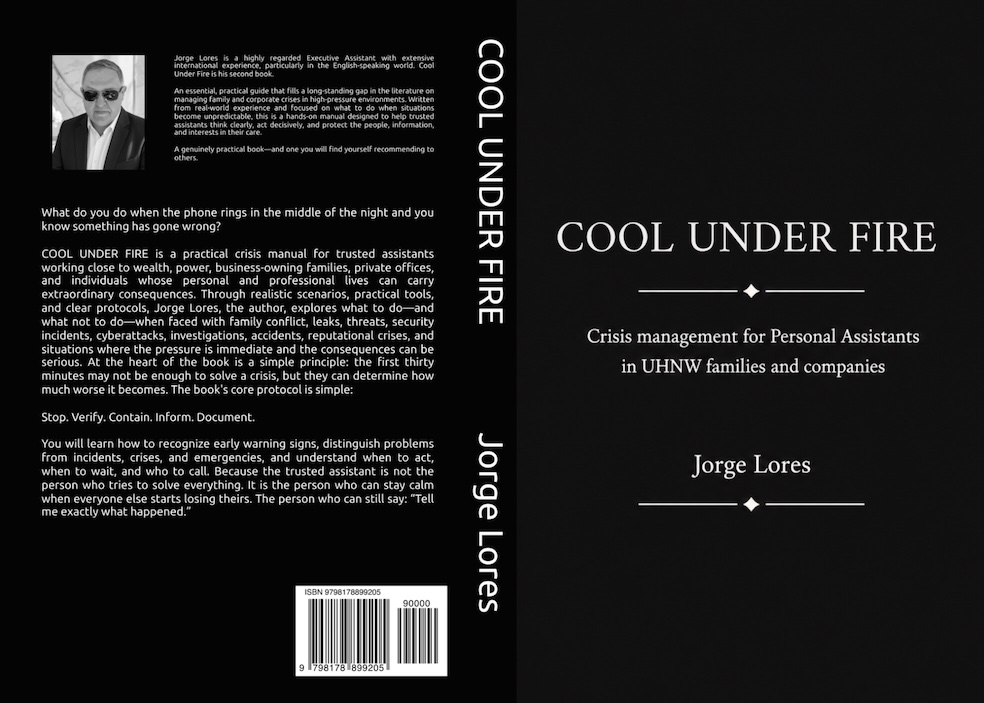
COOL UNDER FIRE (Edición en español: «SANGRE FRÍA. Manual de crisis para el asistente de confianza».
Es este un libro muy esperado. Aunque no tenemos vínculo con este autor, sus libros son extremadamente apreciados porque plantean las cosas desde la eminencia práctica de la realidad. Es por ello que la aparición en Estados Unidos de esta obra está siendo extremadamente bien acogida por profesionales y corporaciones y por este mismo motivo hemos decidido hacer mención a ella en nuestras noticias y blog. Un libro ÚTIL con mayúsculas y sorprendentemente práctico. Dice su reseña principal:
¿Qué haces cuando el teléfono suena a las tres de la madrugada y sabes, antes incluso de contestar, que algo acaba de salir mal?
Un accidente. Una separación. Un hijo en problemas. Una amenaza. Una filtración. Una investigación. Un escándalo que empieza a propagarse por internet. Una llamada de un periodista. Una orden de tu empleador que te coloca frente a una frontera que no deberías cruzar.
En el mundo del asistente de confianza, las crisis rara vez llegan con aviso. Y tampoco suelen empezar donde uno espera. A veces comienzan en una conversación familiar. O en un mensaje de Threema o de Simplex. En una llamada perdida. En una fotografía. En un correo que alguien no debería haber enviado. En una puerta que se cierra demasiado deprisa.
Y muchas veces, el primer teléfono que suena no es el del abogado, el médico, el director de seguridad o el responsable de comunicación.
Es el del asistente.
Cool Under Fire nace de la realidad: cuando una crisis irrumpe, la discreción, la organización y la experiencia siguen siendo necesarias, pero ya no son suficientes. En esos primeros minutos hay que saber distinguir lo urgente de lo importante, separar los hechos de las suposiciones, proteger la información, preservar evidencias, contener el impacto y poner en marcha a las personas adecuadas sin crear un problema nuevo mientras se intenta resolver el primero.
Este no es un libro para leer cómodamente y olvidar después en una estantería.
Es un libro para tener cerca.
Un manual de consulta para esos momentos en los que alguien necesita respuestas y todavía nadie sabe exactamente qué está pasando.
El autor recorre, a través de situaciones ficticias pero perfectamente reconocibles, algunos de los escenarios más delicados a los que puede enfrentarse un asistente personal que trabaja cerca del poder, del patrimonio, de familias empresarias o de personas cuya vida privada y profesional está sometida a una exposición extraordinaria. Conflictos familiares, separaciones, herencias, hijos problemáticos, adicciones, infidelidades, problemas de salud, conflictos dentro del servicio, salidas inesperadas de directivos, filtraciones, disputas entre socios, sucesiones, auditorías, reguladores, amenazas, acoso, secuestros, ciberataques, suplantaciones, prensa, redes sociales, accidentes, viajes, evacuaciones y crisis de reputación aparecen aquí no como teoría abstracta, sino como problemas que exigen decisiones concretas.
Y el verdadero tema del libro, indicado en sus reseñas, va todavía más allá.
Cómo pensar cuando la presión intenta pensar por ti.
Porque una crisis tiene una lógica propia. Las emociones corren más deprisa que los hechos. La prensa puede correr más deprisa que la investigación. Y las consecuencias legales pueden avanzar mientras todo el mundo sigue intentando averiguar qué ha ocurrido.
Por eso Sangre Fría introduce herramientas diseñadas para devolver estructura al caos: el protocolo de los primeros treinta minutos —Parar. Verificar. Contener. Informar. Documentar.—, la distinción entre problema, incidente, crisis y emergencia, la Escala de Calor, los tres relojes de una crisis —el emocional, el mediático y el legal— y una metodología para reconocer señales tempranas y construir una red de emergencia antes de necesitarla.
No se trata de convertir al asistente en abogado, médico, investigador, especialista en seguridad o responsable de comunicación.
Se trata de algo mucho más práctico: saber dónde termina tu responsabilidad, dónde empieza la de otro profesional y, sobre todo, cuándo ha llegado el momento de llamarlo.
Porque en una crisis, intentar hacerlo todo puede ser tan peligroso como no hacer nada.
El verdadero profesional de confianza no es necesariamente quien tiene una respuesta para cada pregunta. Es quien sabe mantener la cabeza fría cuando todos los demás han empezado a perderla. Quien no confunde velocidad con precipitación. Quien sabe que una información mal transmitida puede causar más daño que la ausencia de información. Y quien entiende que, a veces, la decisión más importante consiste simplemente en detenerse antes de dar el siguiente paso.
Cool under fire es, en definitiva, un libro sobre criterio, confianza y responsabilidad.
Sobre ese territorio invisible en el que trabaja el asistente que está lo suficientemente cerca para enterarse primero, pero que debe saber hasta dónde puede llegar. Porque las crisis no siempre pueden evitarse. Lo que sí puede evitarse es que una crisis se convierta en dos.
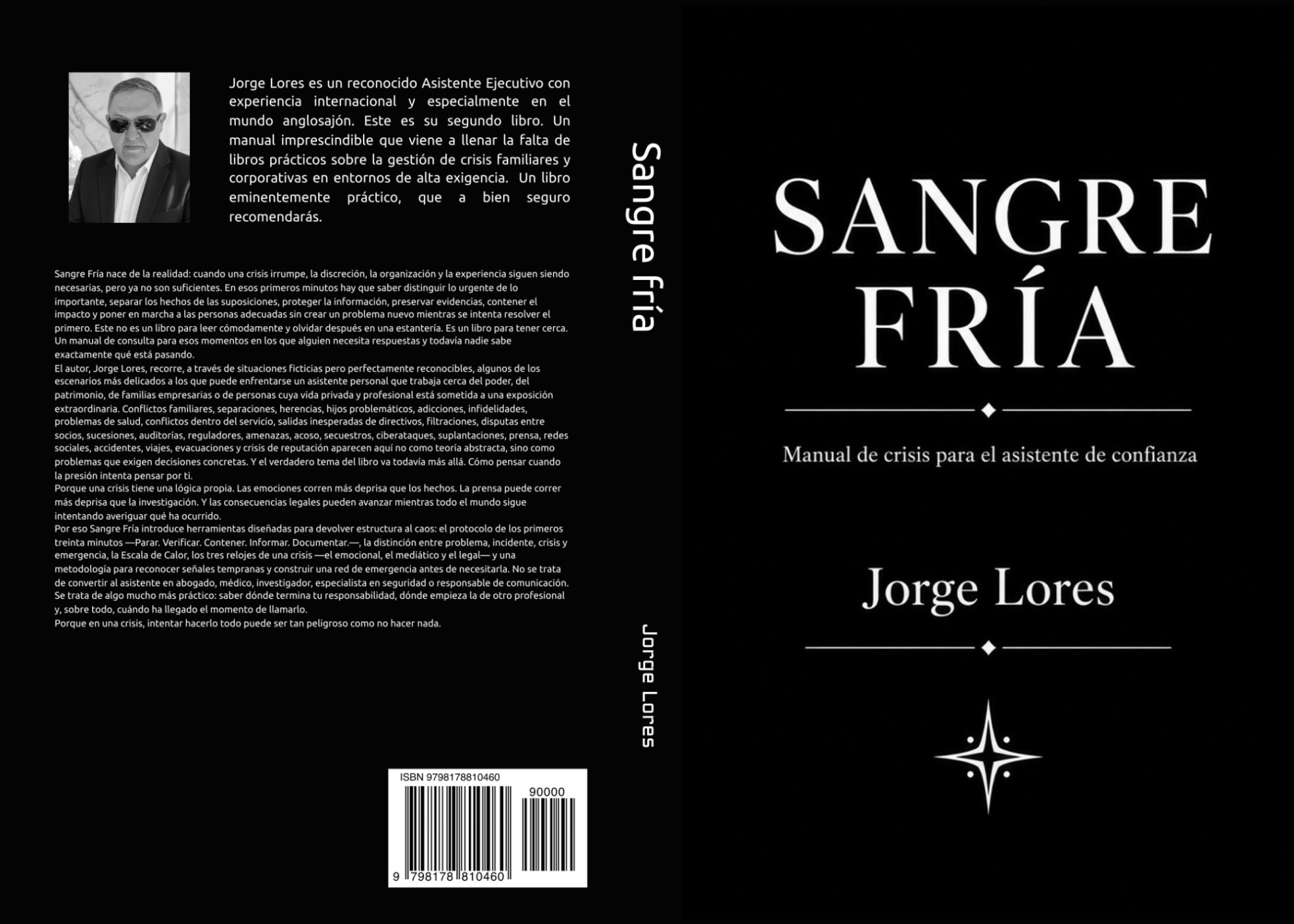
COOL UNDER FIRE
Spanish edition: SANGRE FRÍA. Manual de crisis para el asistente de confianza (SANGRE FRÍA: A Crisis Management Handbook for the Trusted Assistant)
This is a highly anticipated book. Although we have no affiliation with the author, his books are widely appreciated for their grounded, real-world perspective and eminently practical approach. That is why the release of this work in the United States has been so warmly received by professionals and corporations alike. For the same reason, we have decided to feature it in our news section and blog. A genuinely USEFUL book, in every sense of the word, and surprisingly practical. Its main review captures the essence of the book:
What do you do when the phone rings at three in the morning and, even before you answer, you know something has just gone wrong?
An accident. A separation. A child in trouble. A threat. A leak. An investigation. A scandal beginning to spread across the internet. A call from a journalist. An instruction from your employer that puts you face-to-face with a line you should never cross. In the world of the trusted assistant, crises rarely come with a warning. Nor do they usually begin where you expect them to. Sometimes they start with a family conversation. Or a message on Threema or SimpleX. A missed call. A photograph. An email someone should never have sent. A door that closes a little too quickly. And very often, the first phone to ring is not the lawyer’s, the doctor’s, the security director’s, or the head of communications’. It’s the assistant’s.
Cool Under Fire is rooted in reality: when a crisis hits, discretion, organization, and experience remain essential, but they are no longer enough. In those first few minutes, you need to know how to distinguish the urgent from the important, separate facts from assumptions, protect information, preserve evidence, contain the fallout, and bring the right people into action—without creating a second problem while trying to solve the first.
This is not a book to read comfortably and then forget on a shelf. It’s a book to keep close at hand. A practical reference manual for those moments when someone needs answers, yet no one knows exactly what is happening. Through fictional but entirely recognizable scenarios, the author explores some of the most sensitive situations a personal assistant working close to power, wealth, business-owning families, or individuals whose private and professional lives are subject to extraordinary scrutiny may face.
Family conflicts, separations, inheritances, troubled children, addiction, infidelity, health problems, conflicts among household staff, unexpected executive departures, information leaks, disputes between business partners, succession planning, audits, regulators, threats, harassment, kidnappings, cyberattacks, impersonation, the press, social media, accidents, travel disruptions, evacuations, and reputational crises are all addressed here—not as abstract theory, but as real-world problems that demand concrete decisions. The book is available in the United States. And the real subject of the book, as its reviews suggest, goes even further.
How to think clearly when pressure tries to think for you.
Because a crisis has its own logic. Emotions move faster than facts. The press can move faster than an investigation. And legal consequences can unfold while everyone is still trying to figure out what happened. That is why Sangre Fría introduces tools designed to bring structure back to chaos: the first-thirty-minutes protocol—Stop. Verify. Contain. Inform. Document.—the distinction between a problem, an incident, a crisis, and an emergency; the Heat Scale; the three clocks of a crisis—the emotional, the media, and the legal; and a methodology for recognizing early warning signs and building an emergency response network before it is needed. The goal is not to turn the assistant into a lawyer, physician, investigator, security specialist, or communications professional. It is something far more practical: knowing where your responsibility ends, where another professional’s begins, and, above all, when it is time to call them. Because in a crisis, trying to do everything can be just as dangerous as doing nothing. The true trusted professional is not necessarily the person who has an answer to every question. It is the person who knows how to keep a cool head when everyone else has started to lose theirs. Someone who does not confuse speed with haste. Someone who understands that poorly communicated information can cause more damage than no information at all. And someone who recognizes that, sometimes, the most important decision is simply to pause before taking the next step.
Cool Under Fire is, ultimately, a book about judgment, trust, and responsibility. It is about the invisible territory in which the assistant operates: close enough to be the first to know, yet expected to understand the limits of their role.
Because crises cannot always be prevented. What can be prevented is one crisis turning into two.